
§ 382.33 Advance notice requirements.

(a) Except as provided in paragraph (b) of this section, a carrier shall not require a qualified individual with a disability to provide advance notice of his or her intention to travel or of his or her disability as a condition of receiving transportation or of receiving services or accommodations required by this part.
(b) A carrier may require up to 48 hours advance notice and one-hour advance check-in concerning a qualified individual with a disability who wishes to receive any of the following services, types of equipment, or accommodations:
(1) Medical oxygen for use on board the aircraft, if this service is available on the flight;
(2) Carriage of an incubator, if this service is available on the flight;
(3) Hook-up for a respirator to the aircraft electrical power supply, if this service is available on the flight;
(4) Accommodation for a passenger who must travel in a stretcher, if this service is available on the flight;
(5) Transportation for an electric wheelchair on a flight scheduled to be made with an aircraft with fewer than 60 seats;
(6) Provision by the carrier of hazardous materials packaging for a battery for a wheelchair or other assistive device;
(7) Accommodation for a group of ten or more qualified individuals with a disability, who make reservations and travel as a group; and
(8) Provision of an on-board wheelchair on an aircraft that does not have an accessible lavatory.
(c) If a passenger does not meet advance notice or check-in requirements established by a carrier consistent with this section, the carrier shall nonetheless provide the service, equipment, or accommodation if it can do so by making a reasonable effort, without delaying the flight.
(d) Carriers’ reservation and other administrative systems shall ensure that when advance notice is provided by qualified individuals with a disability as provided by this section, the notice is recorded and properly transmitted to operating employees responsible for providing the accommodation concerning which notice was provided.
(e) If the qualified individual with a disability provides the notice required by the carrier for a service under paragraph (b) of this section, the carrier shall ensure that the requested service is provided.
(f) If a qualified individual with a disability provides advance notice to a carrier, and the individual is forced to change to the flight of a different carrier because of the cancellation of the original flight or the substitution of inaccessible equipment, the first carrier shall, to the maximum extent feasible, provide assistance to the second carrier in providing the accommodation requested by the individual from the first carrier.
Related Resources
Need Help?
Have questions about pet air travel? Visit our FAQ page or explore our comprehensive guides.
View FAQsYou Might Also Like

CDC announced final rule to its dog and cat importation regulation
On May 13, 2024, the Centers for Disease Control and Prevention (CDC), Department of Health and Human Services (HHS) issued its final ruling associated with the importation of dogs into the United States to provide clarity and safeguards that address the public health risk of dog-maintained rabies virus variant (DMRVV). This final rule addresses the importation of cats as part of overall changes to the regulations affecting both dogs and cats, but the final rule does not require that imported cats be accompanied by proof of rabies vaccination and does not substantively change how cats are imported into the United States.
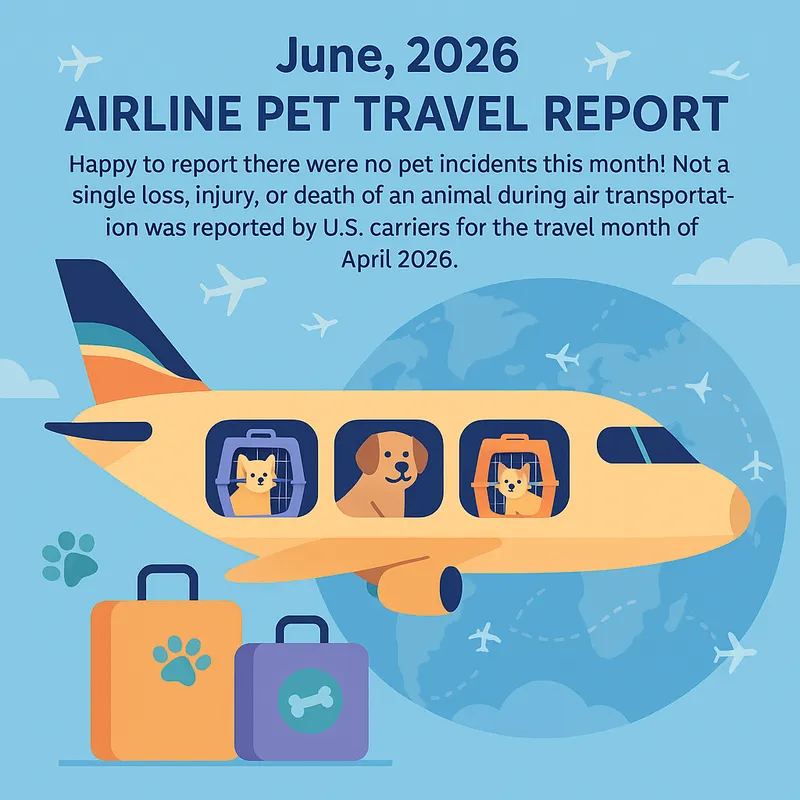
June 2026 Airline Pet Travel Report
Happy to report there were no pet incidents this month! Not a single loss, injury, or death of an animal during air transportation was reported...
2025 Airline Pet Travel Summary
In 2025, U.S. airlines reported 8 pet-related air travel incidents — down 33% from the 12 recorded the prior year. The year's incidents spanned four carriers: Alaska Airlines led with 3 incidents, including 2 deaths, followed by American Airlines with 3 incidents including the year's only reported pet loss. Delta and United Airlines each recorded 1 incident. Deaths fell sharply from 8 in 2024 to 3 in 2025, though the year closed on a somber note with the December death of Meli, a three-year-old Golden Retriever, on an Alaska Airlines flight in Seattle.
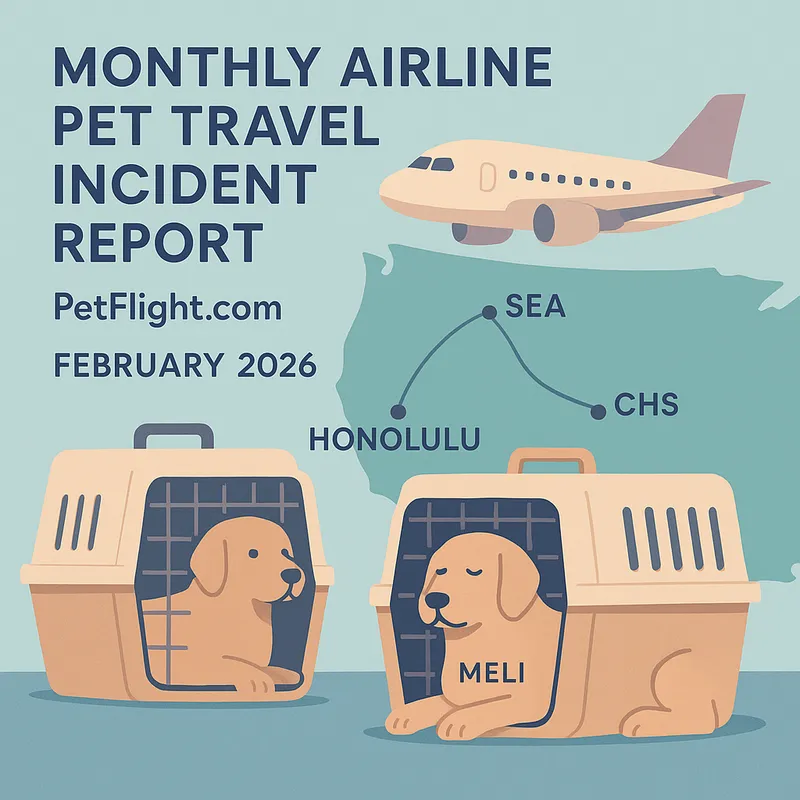
February 2026 Airline Pet Travel Report
December 2025 Animal Transport Consumer Report This month we have one incident to report, from Alaska Airlines. Alaska Airlines reported the...

2024 Airline Pet Travel Summary
In 2024, the U.S. Department of Transportation (DOT) documented 12 pet-related air travel incidents, comprising 4 injuries and 8 deaths, with no reported losses.
Airline Pet Policies Compared: In-Cabin and Cargo Options (2026)
How the major U.S. airlines compare on pet travel: which carriers allow pets in the cabin, which still offer hold or cargo transport, what drives the real differences between policies, and a booking checklist to avoid surprises.